

Do They Still Force Female Marines To Wear Makeup

WASHINGTON -- New changes to training and appearance standards are slated to accept effect next calendar month, every bit part of the Army'due south commitment to improve the wellbeing of all Soldiers.
Regular army senior leaders approved several upcoming grooming and appearance modifications, said Sgt. Maj. Brian Sanders, senior enlisted leader of Army G-one'southward compatible policy co-operative.
The proclamation volition be followed by an all-Army activities bulletin that will have event late February and will supersede the standards outlined in the training and appearance affiliate of Army Regulation 670-1 until the side by side scheduled revision.
"This is one of the many facets of putting our people get-go and recognizing who they are as homo beings," he said. "Their identity and various backgrounds are what makes the Army an ultimate fighting force."
The changes originated from a panel of 17 Soldiers -- 15 women and 2 men -- who assessed a list of proposed training and appearance modifications continued to the professional advent, health and wellness, diversity, and inclusion of Soldiers.
The console included Soldiers from all components, representing a cross-section of ranks, units, ages, cultural backgrounds, career fields and races. The process too included ii Army dermatologists, an Regular army psychologist, and an Army equal opportunity advisor equally subject field-matter experts, who provided medical or EO noesis to dorsum the panel's findings.
The push to alter the Ground forces's training standards proves that the force is evolving and making a concerted effort to make everyone feel included, said Master Sgt. Quintana Mitchell, the uniform policy NCO for Grand-i.
"I use the analogy, 'If you lot expect good, you lot feel proficient -- and if you experience good, y'all perform [well]," Sanders said. "If I am in the Army long enough, it would be nice to see how these changes have improved productivity ... and brand Soldiers perform amend."
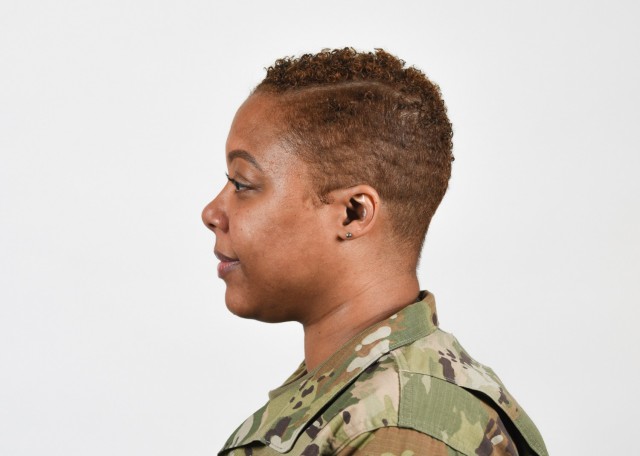
Minimum hair length
One of the updates volition authorize no minimum pilus length for all personnel, to include making information technology an optional style for female Soldiers. Under the current policy, a Soldier's hair length can be no shorter than ane/4 inch from the scalp unless otherwise exempt due to a medical condition or injury.
Panel findings adamant that females attention Ranger, Special Forces, or Sapper training were ofttimes encouraged to cut their pilus to bide by wellness and hygiene recommendations while preparation in an austere environment, Sanders said.
If the Soldier were to washout or graduate from preparation, their hair was often below the 1/4 inch minimum length requirement and outside Army regulations.

Multiple hairstyles
Soldiers will too exist authorized to wear multiple hairstyles as long as it maintains a dandy and professional appearance, and if the hairstyle doesn't impede the use of headgear or other equipment, Sanders said.
Under the current standard, Soldiers are allowed to braid, twist, lock, or cornrow their hair if they are uniform and no greater than i/2 inch in width. Individuals must also take advisable size and spacing between each braid, cornrow, twist, or lock, and are authorized 1 singled-out type of hairstyle at one time. The updated standard removes the constraints of dimension requirements.
By eliminating some of the restrictions, Soldiers will now accept more than flexibility, all while keeping it within the confines of professionalism, Mitchell said. Further, having a choice to vesture multiple hairstyles will permit female person Soldiers more than ways to secure their pilus so that it tin fit appropriately under their headgear.
Ponytails
Female Soldiers with medium-length pilus will have the pick to wear a ponytail if the individual'due south hair length or texture prevents them from securing it into a tight bun, Sanders said. A medium-length hairstyle must extend more than one inch from the scalp and cannot exceed the lower border of the collar in all uniforms.
Under the new policy, medium-length ponytails are only authorized for vesture on the dorsum of the scalp and cannot exceed the caput's width or interfere with the proper wear of a Soldier'southward headgear.
The updated standard will likewise allow females with long pilus the option to vesture a ponytail while wearing an Army Combat Uniform during physical training, or while wearing tactical headgear during tactical training or combat operations. The Regular army defines long hair every bit a length that extends beyond the collar. Army standards require this hairstyle to exist neatly and inconspicuously fastened above the collar'south lower border.
"We can't tell a Soldier to cutting their hair so their helmet can fit," Sanders said. "We tin can still allow a female Soldier with longer hair to put into a long ponytail and tuck it in their ACU top so they can yet deport their mission."
Dermatologists involved in the review process provided critical input tied to the updated ponytail policy, Sanders said. The authorized clothing of a medium-length ponytail could lower an individual'due south risk of hair loss, reduce scarring, or decrease the likelihood of migraine headaches acquired by repeatedly pulling hair into a tight bun.
The lack of hairstyle options as a result of a Soldier'due south hair length or texture tin often stress an private every bit they endeavour diverse techniques and devices to secure their hair to maintain a neat advent, Mitchell said.
Hair highlights, root growth
The Army plans to qualify the wear of highlights if it presents a natural appearance and is non a prohibited color, Sanders said. Further, if a Soldier decides to colour or highlight their pilus, root growth of a different color should non exceed 1.five inches of the original color.
"Some Soldiers develop natural highlights," Sanders said. "We cannot presume that a Soldier'due south hair should exist a specific colour" based on their complexion.
Under the electric current regulation, Soldiers are merely authorized to dye, tint, or bleach their pilus. The color of their hair must too be compatible and non detract from their professional appearance. Unauthorized pigments include, merely are not limited to, purple, blue, pink, green, orange, brilliant blood-red, and fluorescent or neon colors.
"The accent is on natural hair colors," Mitchell said. "It doesn't necessarily have to be a color that is typically seen on a sure ethnic group. It just has to be a natural hair color" that presents a neat and professional image.
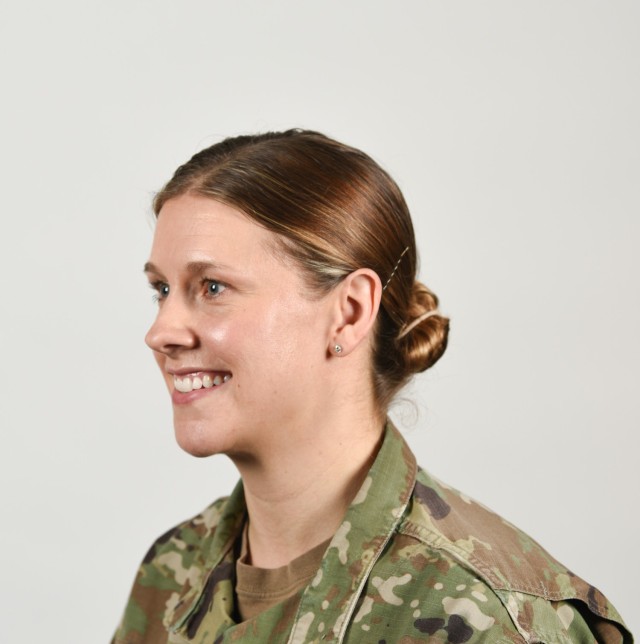
Optional article of clothing of earrings with ACU
Female Soldiers will soon be authorized to clothing earrings with their ACU. Earrings can either be screw-on, prune-on, or post-type earrings in golden, silver, or diamond and must exist unadorned and spherical without exceeding six mm or 1/4 inch in bore.
Pearl earrings are not authorized with the ACU, Sanders said. Females are currently authorized to wear earrings when wearing their service, dress, mess, and evening mess uniforms.
Individuals volition non be allowed to wear earrings in a field surround or during a combat-related deployment, or in locations where access to regular hygiene is limited.
"Our identity is important," Sanders said. "If we intendance almost people offset and the Soldier as a whole, nosotros accept to intendance nigh the many aspects to who they are equally well. This is a small-scale, but significant change that positively impacts a considerable size of our forcefulness."
Additional colors of lipstick, nail smooth
Along with supporting a Soldier'due south identity, the Army approved the apply of additional colors of lipstick and nail polish, including the wearable of clear nail shine by male person Soldiers. Females besides have the selection to article of clothing an American manicure, a ii-tone nail mode that maintains a natural appearance.
"Some male Soldiers in certain occupation specialties rely on their hands, which are under constant battery while working with tools or harsh chemicals," Sanders said. "A male Soldier would take this opportunity to continue their nails protected."
Co-ordinate to the updated policy, extreme colors and smash shapes, such as a bury, ballerina, and stiletto nails, are prohibited while in uniform or on duty in civilian clothes. Unauthorized pigments include, but are not limited to, purple, bluish, pinkish, green, orange, brilliant red, and fluorescent or neon colors.
Offensive wording alter, updated imagery
Another update will remove and replace potentially offensive and weaponized words and phrases, such equally "Mohawk, Fu Manchu, dreadlock, eccentric, and faddish," Sanders said.
Army officials are currently replacing phrases of concern with alternative verbiage to provide increased clarity and guidance well-nigh a Soldier's professional appearance based on condom, good order, and armed forces bearing -- instead of relying on the phrase at the discretion of the commander.
"This is how nosotros shift the culture and embrace forward thinking," Sanders added. "Information technology is fourth dimension to dig deeper and apply our lexicon and vocabulary to describe what is authorized and what does not conform to a professional military appearance, practiced social club and discipline."
The updated standard will besides include a link to imagery and videos to provide Soldiers with specific examples of proper preparation and appearance standards, Sanders said. Current images are too vague, outdated, and leave also much room for interpretation without adequate guidance.
"Pictures speak 1,000 words," he said. "Nosotros won't exist able to capture every training and appearance standard, but we will be able to categorize them to equip Soldiers at all levels" with the information needed to ensure regulatory standards are being realized in a fair and inclusive way that is easily understood across the force.
Related links:
Army News Service
ARNEWS archive
STAND-TO! Army grooming standards and AR 670-1
Revised Army regulation and grooming standards support diverseness, equity and inclusion and people outset priority
Source: https://www.army.mil/article/242536/army_announces_new_grooming_appearance_standards
Posted by: davenportwornat1995.blogspot.com
0 Response to "Do They Still Force Female Marines To Wear Makeup"
Post a Comment